The Americans with Disabilities Act (ADA) is a civil rights law designed to ensure equal access to goods, services, and information for people with disabilities. While many businesses understand their physical accessibility obligations, digital accessibility, especially website accessibility is now one of the most common sources of legal risk.
As more services move online, businesses with websites that are not ADA compliant face a growing number of lawsuits. Accessibility compliance offers a proactive way to reduce this risk, improve usability, and demonstrate good-faith efforts to meet ADA requirements before legal action occurs.
What Is an ADA Lawsuit and Why They Are Increasing
An ADA lawsuit occurs when an individual claims that a business has failed to provide equal access as required by the ADA. In recent years, lawsuits related to website accessibility have increased significantly.
This rise is driven by several factors:
- Websites are now primary points of access for services and transactions
- Courts increasingly recognize websites as places of public accommodation
- Accessibility standards like WCAG are widely accepted as benchmarks for compliance
- Advocacy and awareness around digital accessibility continue to grow
As a result, businesses that overlook digital accessibility are more likely to face ADA compliance lawsuits, even if they have never received a complaint before.
How Website Accessibility Lawsuits Typically Happen
Most website accessibility lawsuits follow a predictable pattern. They often begin when a user with a disability encounters barriers that prevent them from using a website.
Common triggers include:
- Missing alternative text for images
- Inaccessible forms or checkout processes
- Navigation that cannot be used with a keyboard
- Poor colour contrast
- PDFs or documents that are not accessible
In many cases, the business receives a demand letter alleging ADA non-compliance and requesting remediation, settlement, or both. If the issue is not resolved, the matter may escalate into formal legal action.
Because accessibility barriers are easy to identify through automated scans and manual testing, websites are frequently targeted.
How Accessibility Compliance Protects Businesses
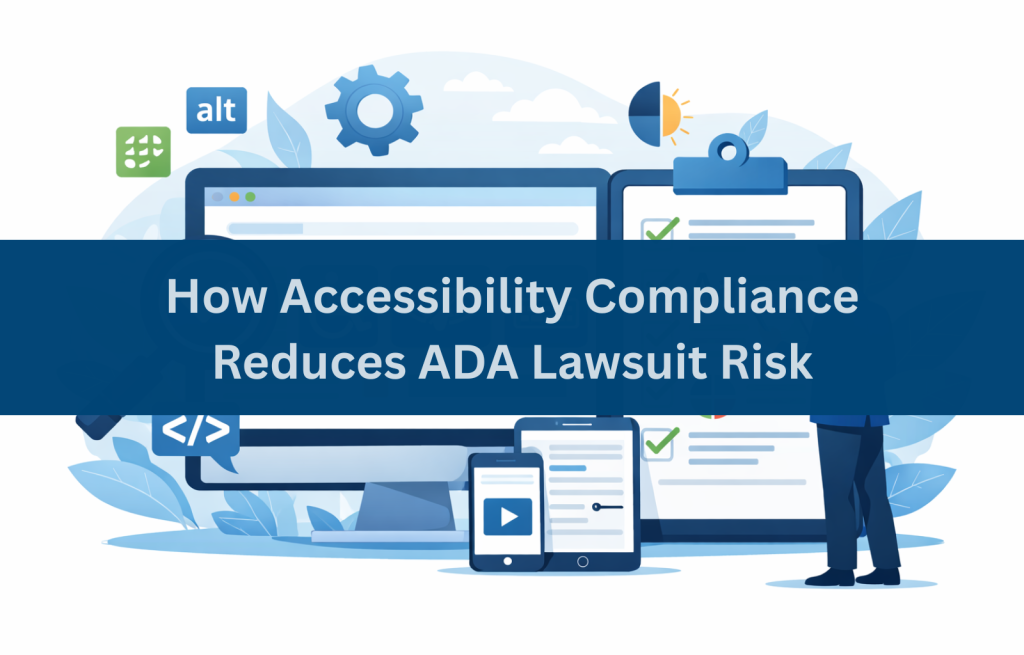
Accessibility compliance is one of the most effective ways to reduce ADA lawsuit risk. When businesses take proactive steps to meet accessibility standards, they significantly lower their legal exposure.
Compliance helps by:
- Demonstrating a good-faith effort to meet ADA obligations
- Reducing the likelihood of user complaints
- Making it harder for plaintiffs to claim negligence
- Improving usability for all users
Courts often look more favorably on organizations that can show documented efforts to address accessibility, even if minor issues still exist. In contrast, businesses with no accessibility plan or testing history face higher risk.
Accessibility Audits as a Lawsuit Prevention Tool
An accessibility audit is a structured evaluation of a website or digital platform against recognized accessibility standards. Audits are a key prevention tool for ADA website compliance lawsuits.
A comprehensive audit typically includes:
- Automated testing to identify common accessibility issues
- Manual testing to evaluate usability and structure
- Assistive technology testing (screen readers, keyboard navigation)
- Review of templates, navigation, forms, and documents
Audits help businesses identify accessibility gaps early before they lead to complaints, demand letters, or lawsuits.
The Cost of an ADA Lawsuit vs the Cost of Compliance
The financial impact of an ADA lawsuit often far exceeds the cost of proactive accessibility compliance.
Potential Costs of an ADA Lawsuit
- Legal fees
- Settlement or remediation costs
- Court-mandated timelines
- Emergency remediation under pressure
- Business disruption
- Reputational damage
Even small businesses can face significant financial strain from an ADA compliance website lawsuit.
Cost of Proactive Compliance
- Accessibility audits
- Planned remediation
- Ongoing monitoring
- Staff training
Compliance allows organizations to spread costs over time and avoid crisis-driven expenses.
Ongoing Accessibility Monitoring and Risk Reduction
Accessibility compliance is not a one-time project. Websites change frequently through new content, design updates, and software upgrades.
Ongoing monitoring helps reduce long-term ADA lawsuit risk by:
- Catching new accessibility issues early
- Maintaining WCAG alignment over time
- Ensuring third-party updates remain accessible
- Supporting continuous improvement
Regular reviews, testing, and updates help businesses stay compliant and avoid falling out of alignment.
Accessibility Compliance Support for ADA Lawsuit Prevention
Professional accessibility services provide the expertise needed to navigate complex requirements and reduce risk effectively.
Accessibility specialists help businesses by:
- Conducting audits and remediation
- Interpreting accessibility standards
- Providing documentation of compliance efforts
- Supporting ongoing monitoring and training
Working with accessibility professionals ensures that compliance efforts are accurate, defensible, and aligned with current expectations.
Reduce ADA Lawsuit Risk With Professional Accessibility Support
If your website may not meet ADA accessibility expectations, a professional accessibility audit can help identify risks before they lead to complaints or legal action. Accessibility Innovations provides WCAG-based audits, remediation guidance, and ongoing monitoring to support ADA compliance efforts.
Frequently Asked Questions (FAQs)
Who can file an ADA lawsuit against a business website?
Any individual who encounters accessibility barriers may file a complaint or lawsuit under the ADA.
Why are ADA website lawsuits increasing in the United States?
Digital services have expanded, and courts increasingly view websites as essential public access points.
What is an ADA lawsuit related to website accessibility?
It is a legal claim alleging that a website is not accessible to people with disabilities as required by the ADA.
Can small businesses face ADA lawsuits for website accessibility?
Yes. Business size does not exempt organizations from ADA obligations.
Does having an accessibility statement protect against ADA lawsuits?
No. Statements help communicate intent but do not replace actual accessibility compliance.
How can accessibility compliance help reduce ADA lawsuit risk?
Compliance demonstrates good-faith effort, reduces barriers, and lowers the likelihood of legal action.
Are automated accessibility tools enough to prevent ADA lawsuits?
No. Automated tools identify some issues, but manual testing is required for reliable compliance.
How long does it take to achieve accessibility compliance?
Timelines vary based on website size and complexity, but audits and remediation can begin immediately.